In the world of clear, professional communication, precision is paramount. Few areas demand as much attention to detail, or cause as much confusion, as the Uso Correcto de Números, Fechas y Abreviaturas—the correct use of numbers, dates, and abbreviations in writing. Whether you're crafting a business report, an academic paper, or even a casual email, getting these elements right isn't just about adhering to rules; it's about building trust, enhancing readability, and ensuring your message is understood exactly as intended.
Missteps in formatting can quickly undermine your credibility, leading to misunderstandings, or at worst, significant errors. Imagine a contract with a misplaced decimal or a critical deadline misread due to an ambiguous date. The stakes are often higher than we realize. This guide will cut through the ambiguity, offering a clear, comprehensive framework to master these essential components of effective writing.
At a Glance: Your Quick Reference
- Capitalization is contextual: Proper nouns, official titles, and specific events get a capital, while generic terms and common names often don't.
- Numbers toggle between words and figures: Simple, approximate, or paragraph-starting numbers are spelled out; exact, complex, or symbol-accompanied numbers use figures.
- Decimal and thousands separators follow a specific convention: Decimals use a comma, and thousands use a point or thin space.
- Dates prioritize clarity: Days of the month and years are always written in figures.
- Abbreviations offer efficiency: Use common, recognized abbreviations for months, days, and time, ensuring they're appropriate for your audience.
- Consistency is key: Once you adopt a style, stick with it throughout your document.
Mastering Capitalization: When to Elevate Your Words
Capitalization isn't merely about starting a sentence; it's a sophisticated system that guides your reader's eye, distinguishing specific entities from general concepts. Following a consistent capitalization strategy elevates your writing, making it professional and easy to navigate.
The Big Impact: When to Capitalize
Always begin a sentence with a capital letter, and capitalize proper nouns—these are the bedrock rules. Beyond that, a range of specific categories demand an initial capital:
- Proper Nouns and Their Derivatives: This includes names of people, animals, objects, and places (José Artigas, Scooby Doo, Patagonia). This extends to full official names of institutions (Partido Socialista Obrero Español, Fiat) and brands (Fiat).
- Siglas and Roman Numerals: Acronyms (ONU for United Nations) and Roman numerals (XVI for 16th century) are consistently capitalized.
- Titles and Official Designations: Full, official titles of historical periods (Edad Media - Middle Ages), festivities (Navidad - Christmas), and significant sports or cultural events (Copa del Mundo - World Cup) are capitalized. The names of state powers (Poder Ejecutivo - Executive Branch) and their official bodies also fall into this category.
- Abstract Entities: When referring to widely recognized abstract entities that function as specific proper nouns, capitalize them (e.g., el Estado - the State).
- Legal and Formal Documents: The complete names of laws, declarations, treaties (Tratado de Tordesillas - Treaty of Tordesillas), and official congresses, fairs, or festivals (XV Festival de Cine Independiente) are capitalized.
- Media and Groups: Names of specific newspapers (La Diaria), sports teams (Real Sociedad), and artistic groups (Nirvana) are proper nouns and thus capitalized.
- Direct Quotes and Salutations: Capitalize the first word of a direct quotation following a colon. Similarly, capitalize the first word after the salutation in a letter.
Remember, capital letters carry accents (tildes) according to general rules (e.g., ÁGUILA). Avoid using capitalization merely for emphasis, as this can detract from professionalism.
The Subtle Art: When to Use Lowercase
Just as important as knowing when to capitalize is understanding when to use lowercase. This is where many writers falter, often over-capitalizing out of a desire for emphasis, which ultimately dilutes clarity.
- Common Nouns: General terms for people, places, or things remain in lowercase.
- Temporal Units: Days of the week, months, and seasons are typically lowercase (lunes, marzo, otoño) unless they are part of a proper name (e.g., Avenida 8 de Octubre).
- Generic Geographic and Urban Features: Generic terms like "island" (la isla de Flores) or "street" (la calle) are lowercase unless they are an integral part of a specific proper name (e.g., la Avenida del Libertador).
- Generic Institutions: When referring to institutions generally, use lowercase (e.g., "four ministries" - cuatro ministerios).
- Titles and Positions (Context-Dependent): Official titles, academic degrees, dignities, and forms of address (e.g., "president," "minister") are written in lowercase when they accompany a proper name or refer to a general scope (e.g., "el rey Felipe IV" - King Philip IV, "el presidente de Nicaragua" - the president of Nicaragua). When used alone as a specific title, they might be capitalized (e.g., "the President issued a decree"), but generally, the trend is towards lowercase unless it's a very formal direct address.
- Academic Disciplines: Subjects or fields of study (odontología - dentistry) are lowercase unless they are part of an institution's official name (e.g., Facultad de Derecho - Faculty of Law).
- Economic and Sociological Concepts: Even if they have acronyms, general economic or sociological concepts remain lowercase (e.g., "el producto bruto interno - PBI" - gross domestic product - GDP).
- Demographics and Directions: Gentilicios (nationalities/ethnicities like alemán - German), derivatives of cardinal points, and names of ethnicities or tribes (charrúa) are lowercase.
- Schools of Thought: Generic denominations of schools or currents of thought (artiguismo) are lowercase, unless they form part of an official designation (e.g., Vertiente Artiguista).
- Work Titles: For titles of books, films, or songs, only the initial word and any proper nouns within the title are capitalized (e.g., El abrazo partido - The Outlaw).
- Diseases and Drugs: Names of diseases (difteria - diphtheria) and generic drugs are written in lowercase, except when they include the name of their discoverer or a proper noun.
Navigating these capitalization rules requires attention, but with practice, it becomes second nature, lending authority and clarity to your prose. For more specific dilemmas on how to phrase complex ideas, you might find guidance on how to write it.
Navigating Numbers: From Digits to Words
Numbers appear everywhere in writing, from exact figures to approximations. The choice between spelling them out and using numerals isn't arbitrary; it's governed by conventions designed to enhance readability and prevent confusion.
When to Spell Out Numbers (Words)
For ease of reading and stylistic flow, certain numbers are best expressed in words:
- Single-Digit Numbers: Generally, numbers from zero to nine are spelled out (e.g., "three days" - tres días).
- Approximate Quantities: When a number isn't exact, or serves as a broad estimate, use words (e.g., "more than a hundred years" - más de cien años).
- Beginning a Paragraph: To maintain a smooth start to a sentence, always spell out a number that begins a paragraph (e.g., "Thirty-six days later..." - Treinta y seis días después...).
- Decades (When Not Referring to Specific Years): When referring to decades, spell them out (e.g., "the nineteen nineties" - la década de los noventa).
- No Unit Symbols: When writing quantities in words, do not use symbols for units of measurement; write out the unit's name.
When to Use Figures (Numerals)
For precision and conciseness, especially when dealing with data, larger quantities, or specific identifiers, numerals are preferred:
- Numbers Accompanied by Symbols: When a number is paired with a symbol for currency, weight, or other units, use figures (e.g., "25.5 kg," "$ 560").
- Exact Quantities Over One Digit: For precise counts greater than nine, use numerals (e.g., "34 degrees" - 34 grados).
- Specific Identifiers: Numbers that follow a proper name, such as route numbers or kilometers, should always be in figures (e.g., "Ruta 9, km 26").
- Statistical Data: This includes prices, population figures, sports scores, and quantities in recipes or ingredients. These require the immediate clarity that figures provide.
The Nuance of Number Formatting: Separators and Abbreviations
Beyond deciding between words and figures, how you format the numerals themselves is critical. This is particularly true for large numbers and decimals, where conventions can differ across languages and contexts.
- Thousands Separators: To improve readability for large numbers, separate thousands with either a point (e.g., 24.187.216) or a thin space (e.g., 24 187 216). This ground rule, while common in many parts of the world, differs from the standard US English practice of using a comma for thousands. When writing for a US English audience, clarity is key, so consider your audience's expectations or provide a brief note if adhering to this specific convention.
- Years: Years are written as continuous figures, without any separators (e.g., 2009).
- Decimal Separators: Crucially, to separate whole numbers from decimals, use a comma, not a point. For example, "twenty-five and a half kilograms" would be written as 25,5 kg. This is another area where the guideline, while standard in many contexts globally, differs from US English, which uses a period (e.g., 25.5 kg) as the decimal separator. For consistency with the provided ground truth, we adhere to the comma as the decimal separator. If your audience is strictly US English, ensure you clarify this convention or adapt to their standard using a period if the context allows.
- Hours and Minutes: Separate hours and minutes using either a point or a colon (e.g., 10.30 or 10:30).
- Line Breaks: Avoid separating a number from its accompanying unit when transitioning to a new line. Keep them together for immediate context.
- Abbreviating Large Round Numbers: For extremely long, round numbers, you can abbreviate by stating the core number and the magnitude (e.g., "mil" for three zeros, "millón/millones" for six zeros, "billón/billones" for twelve zeros). This provides a concise way to express vast figures without clutter. For instance, instead of 1,000,000,000,000, you might write "un billón."
The careful application of these rules ensures that your numerical data is not just present but also immediately comprehensible, preventing misinterpretation.
Precision in Dates: More Than Just Day and Month
Dates are among the most frequently written pieces of information, yet their formatting can be a source of constant confusion. A clear and consistent approach to dates is vital for scheduling, historical reference, and legal documentation.
The Foundation of Date Writing
- Days of the Month and Years: These are always expressed using figures. For example, "the 15th of August, 2024" would incorporate the figures for the day and the year.
- Months and Seasons: As previously noted, months (enero, febrero, etc.) and seasons (primavera, otoño) are typically written in lowercase. The exception is when they form part of a proper name, like "Avenida 8 de Octubre" (October 8th Avenue).
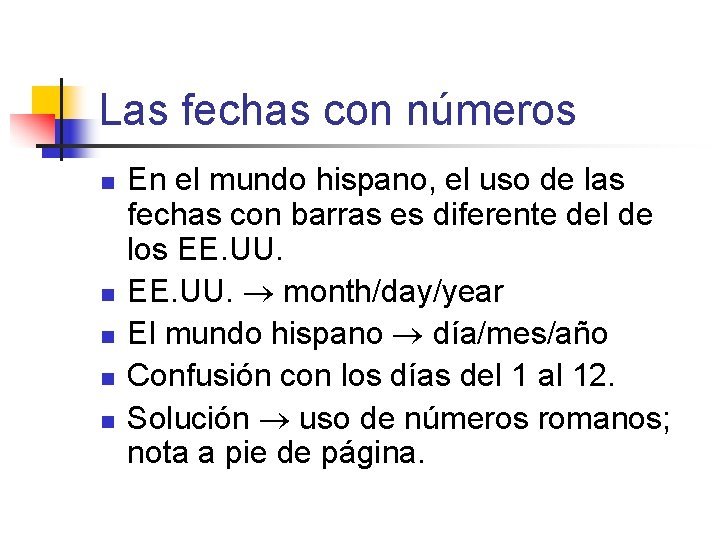
- Complete Dates: While the specific order of day/month/year can vary by regional convention (e.g., DD/MM/YYYY vs. MM/DD/YYYY), the key is to be consistent within your document and clear for your intended audience. When writing out dates in full, ensure proper capitalization for any specific holidays or official event names, while keeping generic month and day names lowercase.
For instance, "Tuesday, March 26, 2024" combines the lowercase day and month with figures for the day of the month and year. This careful blend respects both capitalization and numeral rules.
The Art of Abbreviating: Short and Sweet, But Smart
Abbreviations offer a valuable tool for conciseness, saving space and speeding up reading. However, their use requires discretion. Over-abbreviating can lead to ambiguity, while inconsistent use looks unprofessional.
Common Abbreviations for Dates and Time
The ground truth provides specific abbreviations for days of the week, months, and time units. These are generally understood and accepted in formal and informal writing alike:
- Months:
- Ene. (enero - January)
- Feb. (febrero - February)
- Mar. (marzo - March)
- Abr. (abril - April)
- May. (mayo - May)
- Jun. (junio - June)
- Jul. (julio - July)
- Ago. (agosto - August)
- Sept. (septiembre - September)
- Nov. (noviembre - November)
- Dic. (diciembre - December)
- (Note: The ground truth omits "Octubre" (October). For completeness, "Oct." would be its logical abbreviation).
- Days of the Week:
- Lun. (lunes - Monday)
- Mart. (martes - Tuesday)
- Miérc. (miércoles - Wednesday)
- Juev. (jueves - Thursday)
- Vier. (viernes - Friday)
- Sáb. (sábado - Saturday)
- Dom. (domingo - Sunday)
- Time Units:
- Hrs. (horas - hours)
- Min. (minutos - minutes)
- Seg. (segundos - seconds)
Understanding AM and PM: Time of Day Markers
For the 12-hour time format, "am" and "pm" are essential for distinguishing between morning and afternoon/evening. The ground truth states:
- "am" (Antes del mediodía - Before midday): Used for times from 1:00 to 12:00 (midnight).
- "pm" (Después del mediodía - After midday): Used for times from 12:00 (noon) to 24:00 (midnight).
It's crucial to clarify this, as the ground truth's definition can be interpreted in ways that diverge from standard US English conventions. In US English, the standard is: - 12 AM: Midnight (the start of a new day)
- 12 PM: Noon (midday)
So, following the spirit of "Antes del mediodía" and "Después del mediodía" but applying US English interpretation: - am: Refers to the period from midnight (12 AM) up to, but not including, noon (12 PM). (e.g., 1:00 am, 11:59 am).
- pm: Refers to the period from noon (12 PM) up to, but not including, midnight (12 AM). (e.g., 12:00 pm, 5:30 pm, 11:59 pm).
When using these abbreviations, ensure your audience is familiar with the 12-hour format, or consider using the 24-hour format (e.g., 17:30 for 5:30 pm) for maximum clarity in international or technical contexts.
Common Pitfalls and How to Avoid Them
Even with clear rules, it's easy to stumble into common traps. Recognizing these pitfalls is the first step to avoiding them, safeguarding your credibility and the clarity of your message.
Pitfall 1: Inconsistent Formatting
One of the most frequent errors is a lack of consistency. You might spell out "three" in one sentence and use "3" in a similar context later on. You might use a point for thousands in one table and a thin space in another.
- How to Avoid: Establish a style guide (even if it's just a mental one) before you start writing. For complex documents, literally write down your chosen conventions for numbers, dates, and abbreviations. A quick review at the end of your writing process, specifically looking for consistency, can catch many errors.
Pitfall 2: Misunderstanding Contextual Capitalization
Confusing a generic term with a specific proper noun is another common slip. For example, capitalizing "president" when referring to any president versus "President Smith" or "the President of the United States."
- How to Avoid: Always ask: Is this a unique, named entity or a general category? If it's a general category, lean towards lowercase. If it's a specific, official name or title, capitalize. Review the specific rules for titles, disciplines, and generic geographic features carefully.
Pitfall 3: Decimal vs. Thousands Separator Confusion
This is particularly tricky given the differing conventions across languages. Using a period for decimals when a comma is expected (or vice-versa) can change the numerical value entirely.
- How to Avoid: For this guide, we adhere to the ground truth: comma for decimals, point or thin space for thousands. If your primary audience is US English, and you're not bound by a specific style guide that dictates otherwise, you might need to make a conscious decision to either:
- Strictly follow the ground truth and add a disclaimer for your US audience.
- Or, adapt to US English standards (period for decimals, comma for thousands) and make an internal note of the divergence from the ground truth provided here.
The key is to choose one and apply it universally within your document.
Pitfall 4: Ambiguous Date Formats
Writing "03/04/2024" can mean March 4th or April 3rd depending on the reader's regional background.
- How to Avoid: Whenever possible, spell out the month (e.g., "March 4, 2024"). If space is extremely limited, and you must use an all-numerical format, consider adopting an international standard like YYYY-MM-DD (e.g., 2024-03-04) or explicitly stating the format at the beginning of your document (e.g., "All dates are in DD/MM/YYYY format").
Pitfall 5: Over-Abbreviating or Using Unrecognized Abbreviations
While abbreviations save space, unfamiliar or excessive use can hinder comprehension. Not every word needs to be shortened.
- How to Avoid: Stick to widely recognized and contextually appropriate abbreviations. If you introduce a less common abbreviation, spell it out on first use, followed by the abbreviation in parentheses, and then use the abbreviation thereafter. For example, "World Health Organization (WHO) announced..."
Beyond the Rules: Cultivating Clarity and Consistency
Understanding the granular rules for numbers, dates, and abbreviations is vital, but true mastery comes from applying these principles with a broader aim: absolute clarity and unwavering consistency. Your goal as a writer is to eliminate any cognitive load on the reader, allowing them to absorb your message effortlessly.
The Reader-First Approach
Always put your reader's experience first. Will a particular formatting choice make it easier or harder for them to understand? If you're writing for a diverse audience, or a global one, lean towards formats that are less ambiguous (e.g., spelling out months instead of numerical date formats). If your audience is highly specialized, certain technical abbreviations might be acceptable that wouldn't be in general correspondence.
Develop Your Personal (or Organizational) Style Guide
For any significant writing project or ongoing communication, consider creating a mini-style guide. This doesn't need to be an elaborate document; a simple page outlining your preferred conventions for numbers, dates, abbreviations, and other common formatting choices can be invaluable. This acts as your definitive reference point, ensuring everyone on your team (or just you, for personal projects) follows the same guidelines. It's a living document that you can refine as new scenarios arise.
Leverage Technology, But Don't Over-Rely
Word processors and grammar checkers can catch many basic errors, but they are tools, not infallible editors. They won't understand the nuanced contextual rules for capitalization or the specific conventions for number separators that might be dictated by a particular style guide (like the ground truth provided here). Use them as a first pass, but always perform a human review with an eye specifically for number, date, and abbreviation formatting.
The Power of Practice
Like any skill, mastering these elements of writing requires practice. The more you write with these rules in mind, the more intuitive they will become. Don't be afraid to consult this guide or your own style sheet frequently. Over time, these precise choices will become ingrained, allowing you to write with greater confidence and impeccable clarity.
Ultimately, correct usage isn't about rigid adherence for its own sake. It's about empowering your message, building trust with your audience, and presenting your ideas with the professionalism they deserve. By diligently applying these principles, you'll ensure your writing is not just understood, but respected.