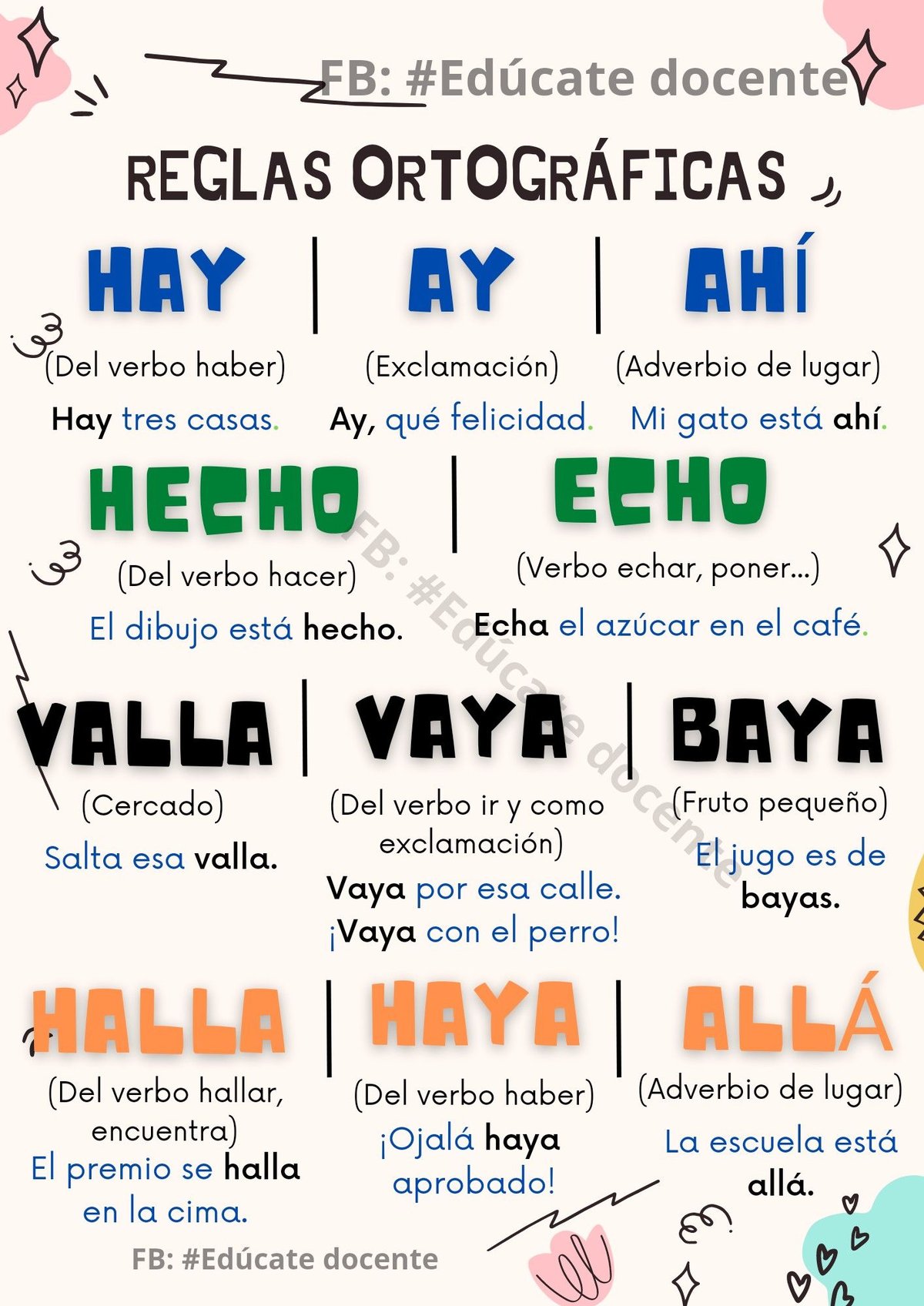
So, you're ready to master Spanish writing? Excellent. Diving into Ortografía y Acentuación isn't just about avoiding red marks; it's about unlocking crystal-clear communication, lending authority to your words, and truly appreciating the elegance of the Spanish language. While it might seem daunting at first, Spanish orthography is remarkably logical, especially compared to some other languages. It’s a system designed for clarity, and once you grasp its core principles, you'll wonder how you ever managed without them.
Think of it as learning the exact notes and rhythm of a beautiful song. You can hum the tune, but knowing the sheet music allows you to play it perfectly, expressively, and with confidence. That's what these rules do for your Spanish.
At a Glance: Your Quick Guide to Spanish Writing Mastery
- The Tilde is Your Friend: The little accent mark (´) isn't decorative; it's essential for pronunciation and meaning.
- General Accentuation Rules: Most words follow predictable patterns based on their stress and ending. Learn agudas, graves/llanas, esdrújulas, and sobreesdrújulas.
- Diacritical Tildes Matter: These differentiate words that are spelled the same but have different meanings or grammatical functions (e.g., si vs. sí).
- Vowel Combinations (Diptongos, Hiatos): How vowels sit together dictates accentuation.
- Capitalization is Specific: Follow rules for proper nouns, beginnings of sentences, and specific titles.
- Punctuation Has Nuances: Don't forget the inverted question (¿) and exclamation (¡) marks!
- Tricky Letters: Certain letter pairs (like B/V or C/S/Z) require careful attention to spelling rules.
- The RAE is Your Guide: The Real Academia Española is the ultimate authority. Use their resources!
Why Perfect Spanish Writing Isn't Just for Perfectionists
In a world filled with digital shortcuts and casual communication, you might wonder if strict adherence to spelling and accentuation really matters. The short answer? Absolutely. Precise orthography isn't about being pedantic; it's about respect – for your reader, for the language, and for your own message.
Poor orthography can completely change the meaning of a sentence, create ambiguity, or even undermine your credibility. Imagine confusing solo (alone) with sólo (only), or el (the) with él (he). These seemingly minor mistakes can lead to major misunderstandings. Mastery of Ortografía y Acentuación empowers you to communicate with precision, clarity, and the authority your ideas deserve. It’s the difference between a rough sketch and a polished, professional blueprint.
Decoding the RAE: Your North Star for Spanish Rules
When it comes to the definitive rules of the Spanish language, there's one authority above all: the Real Academia Española (RAE). Since its founding in 1713, the RAE has served as the guardian of the Spanish language, publishing dictionaries, grammars, and, crucially for our topic, orthography guides.
The latest and most comprehensive guide is the Ortografía de la lengua española (2010), a monumental work that describes the orthographic system in detail and lays out the rules for correct writing today. When we talk about "the rules," we're talking about the RAE's framework. They don't invent rules arbitrarily; rather, they codify and standardize current usage while also providing a historical context. Think of them not as gatekeepers, but as expert cartographers mapping the vast and dynamic territory of Spanish.
The Absolute Basics: Syllables and Stress
Before you can master the tilde, you need to understand the fundamental building blocks of Spanish words: syllables and stress. Every Spanish word has a natural stress, a syllable that is pronounced with greater emphasis. This natural stress, combined with the word's ending, is what dictates whether or not a written accent (a tilde, ´) is needed.
Understanding Word Stress: The Unsung Hero
Spanish words fall into one of four categories based on where their natural stress lies:
- Agudas (Oxytone words): The stress falls on the last syllable. Examples: ca-fé, a-mar, co-ra-zón.
- Graves or Llanas (Paroxytone words): The stress falls on the second-to-last syllable. Examples: ca-sa, ár-bol, li-bro.
- Esdrújulas (Proparoxytone words): The stress falls on the third-to-last syllable. Examples: mé-di-co, pá-ja-ro, té-le-fo-no.
- Sobreesdrújulas (Superproparoxytone words): The stress falls on the fourth-to-last or an even earlier syllable. These are less common and usually involve adverbs ending in -mente or verbs with attached pronouns. Examples: rá-pi-da-men-te, co-mún-di-se-lo.
Why is this important? Because once you know where the natural stress lies, the rules for applying the written tilde become incredibly straightforward.
Mastering the Tilde: Spanish Accentuation Rules
The tilde (´) is arguably the most recognizable and often misused element of Spanish orthography. It's not a mere embellishment; it's a crucial marker that tells you how to pronounce a word and, often, what it means. The RAE's 2010 Ortografía provides a detailed exposition of these rules (RAE, 2010).
The General Rules: Agudas, Graves (Llanas), Esdrújulas, and Sobreesdrújulas
These are the bedrock of Spanish accentuation for polysyllabic words, as outlined in the RAE's general rules (RAE, 3.4.1.2. La acentuación gráfica de las palabras polisílabas).
- Agudas (Stress on the last syllable):
- They carry a tilde if they end in N, S, or a vowel.
- Examples: café, balón, inglés, allá.
- No tilde if they end in any other consonant: comer, azul, libertad.
- Exception: If an aguda word ends in -s preceded by another consonant, it doesn't carry a tilde (e.g., robots, icebergs).
- Graves or Llanas (Stress on the second-to-last syllable):
- They carry a tilde if they do NOT end in N, S, or a vowel. This is the opposite of agudas.
- Examples: árbol, fácil, cárcel, azúcar.
- No tilde if they end in N, S, or a vowel: casa, mesa, orden, problema.
- Exception: If a grave word ends in -s preceded by another consonant, it does carry a tilde (e.g., bíceps, cómics). This helps distinguish it from agudas.
- Esdrújulas (Stress on the third-to-last syllable):
- They ALWAYS carry a tilde. No exceptions.
- Examples: pájaro, teléfono, música, mércuri. This is a gift! If it sounds like an esdrújula, put a tilde on it.
- Sobreesdrújulas (Stress on the fourth-to-last or earlier syllable):
- They ALWAYS carry a tilde. Like esdrújulas, these are always marked.
- Examples: rápidamente, cómeselo, devuélvemelo. These are often adverbs ending in -mente or verbs with attached pronouns.
Quick Clarification: Understanding these four categories and their respective rules will cover the vast majority of words you encounter. Practice identifying the stressed syllable first, then apply the ending rule.
Special Cases: Diptongos, Triptongos, and Hiatos
The interaction of vowels can sometimes complicate accentuation, but once again, the rules are clear. These apply before the general rules for agudas, graves, esdrújulas.
- Diptongo (Diphthong): Two vowels that form a single syllable. This occurs when a strong vowel (a, e, o) combines with a weak vowel (i, u) that is unstressed, or when two weak vowels combine.
- Examples: cielo (cie-lo), ruido (rui-do), puerta (puer-ta).
- If a diptongo needs a tilde according to the general rules, the tilde is placed on the strong vowel. If both are weak, it's placed on the second vowel.
- Example: adiós (a-diós – strong 'o' gets tilde), cuídate (cuí-da-te – weak 'i' gets tilde to break what would be a diptongo).
- Triptongo (Triphthong): Three vowels that form a single syllable. This involves a weak vowel, a strong vowel, and another weak vowel (e.g., i + a/e/o + u).
- Examples: Uruguay (U-ru-guay – though here 'y' acts as 'i'), cambiáis (cam-biáis), averiguáis (a-ve-ri-guáis).
- If a triptongo needs a tilde, it's placed on the strong vowel in the middle.
- Example: limpiáis.
- Hiato (Hiatus): Two adjacent vowels that belong to different syllables. This occurs when two strong vowels are together, or a strong vowel is next to a weak vowel, but the weak vowel carries the stress.
- Examples: poeta (po-e-ta), maíz (ma-íz), baúl (ba-úl).
- Crucially, a hiato with a stressed weak vowel ALWAYS carries a tilde on the weak vowel, regardless of the general accentuation rules. This is a powerful rule to break a diptongo and ensure correct pronunciation.
- Example: país (pa-ís), frío (frí-o), río (rí-o). Even though país ends in 's' (like a grave word that shouldn't have a tilde), the 'i' must be stressed to form a hiato, so it takes a tilde.
The Diacritical Tilde: Distinguishing Identical Words
This is where the RAE's rules on monosyllabic words come in (RAE, 3.4.1.1. La acentuación gráfica de las palabras monosílabas). Generally, monosyllables (words with one syllable) do not carry a tilde. Words like sol, mar, pan, fue, dio, vi are never accented.
However, the diacritical tilde is a special type of accent used to differentiate pairs of words that are spelled identically but have different grammatical functions or meanings. It's about disambiguation.
Common Diacritical Tildes to Master:
| Word with Tilde (Function) | Word without Tilde (Function) | Example with Tilde | Example without Tilde |
|---|---|---|---|
| él (he, him) | el (the) | Él es mi amigo. | El libro es rojo. |
| tú (you - informal subject) | tu (your - possessive) | Tú eres inteligente. | Dame tu número. |
| mí (me - object of preposition) | mi (my - possessive) | Es para mí. | Es mi casa. |
| sí (yes; reflexive pronoun) | si (if; musical note) | Dijo que sí. / Vuelve en sí. | Si llueve, me quedo. |
| sé (I know; imperative of ser) | se (reflexive pronoun; impersonal) | Sé que es verdad. / Sé bueno. | Se lo dijo. |
| dé (subjunctive of dar) | de (of, from) | Espero que me dé un regalo. | Vengo de Madrid. |
| más (more) | mas (but - formal, less common) | Quiero más agua. | Lo intenté, mas no pude. |
| té (tea - noun) | te (you - object pronoun) | ¿Quieres un té? | Te veo luego. |
| aún (still, yet) | aun (even, including, until) | Aún no ha llegado. | Aun así, lo intentaremos. |
| solo (only - adverb) | solo (alone - adjective) | (Old rule: "Sólo quiero uno." New rule: Only use tilde if ambiguity arises.) | Me siento solo. (I feel alone) |
| Important Note on Solo: The RAE specifically states that the adverb solo (meaning "only" or "just") no longer requires a tilde unless there is a genuine risk of ambiguity between the adverb and the adjective solo (meaning "alone"). In most contexts, the meaning is clear without the tilde. For example, "Solo quiero pan" (I only want bread) is perfectly clear without a tilde on solo. Embrace this simplification! |
Beyond the Tilde: Essential Orthography Rules
While accentuation often grabs the spotlight, Ortografía encompasses much more, including capitalization, punctuation, and the correct spelling of individual words. These elements weave together to form the complete fabric of correct Spanish writing.
Capitalization: When to Go Big
Spanish capitalization rules are largely similar to English, but with some notable differences.
- Start of a Sentence: Always capitalize the first word of a sentence.
- Proper Nouns: Names of people (María), places (Madrid, España), organizations (Real Academia Española), brands (Coca-Cola).
- Titles of Respect: Don, Doña, Señor, Señora are generally not capitalized when used with a name (el señor García), unless abbreviating (Sr. García).
- Titles of Works: In Spanish, generally only the first word of a book title, movie title, or song title is capitalized, unless other words are proper nouns.
- Example: Cien años de soledad (One Hundred Years of Solitude).
- Days of the Week and Months: Unlike English, these are not capitalized in Spanish.
- Example: lunes, martes, enero, febrero.
- Nationalities and Languages: Also not capitalized.
- Example: soy español, hablo francés.
- Acronyms: Always capitalized (e.g., RAE, ONU, FIFA).
Punctuation: The Breath and Beat of Spanish
Punctuation guides the rhythm and clarifies the structure of your sentences. Spanish has most of the same punctuation marks as English, but some are used differently or have unique counterparts.
- Inverted Question and Exclamation Marks (¿¡): This is perhaps the most iconic Spanish punctuation mark. Always open questions and exclamations with an inverted mark (¿ or ¡) and close them with the standard one (? or !).
- Example: ¿Cómo estás? ¡Qué sorpresa!
- Commas (,): Used to separate items in a list, clauses, and introduce explanations. The "Oxford comma" (before "y" in a list) is generally not used in Spanish, unless it prevents ambiguity.
- Periods (.): Marks the end of a sentence.
- Semicolons (;): Connects related independent clauses, often where a stronger break than a comma is needed but a period is too definitive.
- Colons (:): Introduces a list, an explanation, or a direct quote.
- Quotation Marks (« » " "): Spanish traditionally uses angle quotes (« ») for primary quotes, with double quotes (" ") for quotes within quotes. Standard double quotes (" ") are also widely accepted.
- Dashes (—): Can indicate an interruption, an explanation, or direct speech in dialogue.
The Tricky Letters: Common Spelling Mix-ups
Spanish pronunciation is often very phonetic, but certain letters and combinations can still trip up learners. Consistent application of these rules improves your general Ortografía.
- B vs. V: A classic challenge. While often pronounced similarly in many Spanish accents (especially in intervocalic positions), their written usage is distinct.
- Rule: Verbs ending in -bir (except hervir, servir, vivir) use B (e.g., escribir, subir).
- Rule: Words starting with bi-, bibl-, bu-, bur-, bus- use B (e.g., bicicleta, biblioteca, buscar).
- Rule: Adjectives ending in -ava, -ave, -avo, -eva, -eve, -evo, -iva, -ive, -ivo use V (e.g., bravo, nuevo, activo).
- C, S, Z: These letters can represent similar sounds, depending on the region.
- C: Before 'a', 'o', 'u' (and consonants), it sounds like 'k' (casa). Before 'e', 'i', it sounds like 'th' (in Castilian Spanish) or 's' (in Latin America) (cena, cinco).
- S: Always sounds like 's' (sol, mesa).
- Z: Before 'a', 'o', 'u', it sounds like 'th' (Castilian) or 's' (Latin America) (zapato, pozo). It never appears before 'e', 'i'; 'c' is used instead (cielo).
- G vs. J:
- G: Before 'a', 'o', 'u', it's a hard 'g' sound (gato, goma). Before 'e', 'i', it's a harsh 'h' sound (like 'j') (gente, girar).
- J: Always has the harsh 'h' sound (jabón, ojo, reloj).
- The Silent H: The letter 'h' is always silent in Spanish. Its presence is purely orthographic, often indicating Latin origins or disambiguating homophones.
- Examples: hola, hacer, ahí.
- LL vs. Y: The sound of 'll' (like 'y' in "yes" or 'j' in "jump" depending on region, known as yeísmo) can be tricky.
- LL: Used in words like llama, calle, llave.
- Y: Used as a vowel ('i') at the end of a word (ley, rey) or as a consonant ('y' sound) at the beginning of a word or between vowels (yo, payaso).
- R vs. RR:
- Single R: Has a soft, single-tap sound (like the 'tt' in "butter" in American English) at the beginning of a word (ratón), after 'n', 'l', 's' (enriquecer), or when it's part of an 'rr' sound written with a single 'r' (Israel). It has a softer, smoother sound between vowels (pero - but).
- Double RR: Has a strong, trilled sound, and always appears between two vowels (perro - dog). Never starts a word with 'rr'.
Word Grouping and Separation: Aparte vs. A parte
Sometimes, what looks like a single word is actually two, and vice versa. This can significantly alter meaning.
- Aparte (adverb or adjective): Meaning "separately," "aside," or "different."
- Example: Pon los libros aparte. (Put the books aside.) / Es un tema aparte. (It's a separate topic.)
- A parte (preposition + noun): Meaning "to a part" or "to a section."
- Example: Se dirigió a parte de la audiencia. (He addressed a part of the audience.)
Other common examples include: - Sino (but rather) vs. Si no (if not): No quiero café, sino té. (I don't want coffee, but rather tea.) vs. Si no vienes, me iré. (If you don't come, I'll leave.)
- También (also) vs. Tan bien (so well): Yo también quiero. (I also want.) vs. Canta tan bien. (He sings so well.)
Numerals, Symbols, and Abbreviations
Even how you write numbers and common symbols falls under orthography.
- Numerals:
- Numbers up to twenty-nine are typically written as single words (veintiuno). From thirty onwards, they are usually written as separate words (treinta y cinco).
- Thousands are separated by periods in Spanish-speaking countries, while decimals use commas. (e.g., 1.234.567,89 – one million, two hundred thirty-four thousand, five hundred sixty-seven and eighty-nine hundredths).
- Currency symbols typically go after the number in Spanish (e.g., 100 €, 50 $, 300 MXN).
- Symbols: Percentages are written with a space between the number and the symbol (e.g., 25 %).
- Abbreviations: Always end with a period, even if it's the last word of a sentence (e.g., Sr. López, EE. UU. for Estados Unidos). Acronyms do not take periods.
Debunking Common Myths and Misconceptions
Despite the RAE's clear guidelines, certain myths about Spanish orthography persist.
- Myth 1: Capital letters don't need tildes.
- Reality: This is FALSE. The RAE explicitly states that uppercase letters do require tildes if the word demands it. The idea that they don't is an outdated misconception from when typewriters couldn't easily produce accented capitals.
- Example: ÁRBOLES, ÉXITO, ÚLTIMO.
- Myth 2: The word solo (adverb) always requires a tilde.
- Reality: As mentioned earlier, the RAE revised this rule. Solo (meaning "only") no longer takes a tilde unless its omission could lead to genuine ambiguity with the adjective solo (meaning "alone"). In most cases, context makes it clear.
- Myth 3: You can put a tilde on any vowel to indicate stress.
- Reality: Absolutely not. Tildes follow specific rules based on word type (aguda, grave, etc.) and vowel combinations (hiato). Randomly adding tildes will result in incorrect spelling and, potentially, confusion.
Your Toolkit for Flawless Spanish Writing
Mastering Spanish orthography and accentuation is a journey, not a destination. It requires consistent effort and a willingness to consult reliable sources. Here’s how to build your toolkit:
- The RAE's Online Resources: The RAE's website (https://www.rae.es/) is your best friend. Their online dictionary (Diccionario de la lengua española) and the Diccionario panhispánico de dudas (DPD) are invaluable for checking specific words or tricky grammatical points. The Ortografía de la lengua española (2010) is the definitive rulebook.
- Read Extensively in Spanish: Immerse yourself in well-written Spanish literature, news articles, and academic texts. The more you see correct spelling and accentuation, the more naturally it will come to you. Your brain will start to recognize patterns subconsciously.
- Practice, Practice, Practice: The only way to truly internalize these rules is through consistent application. Write emails, essays, short stories, or even just journal entries in Spanish. Then, review your work carefully.
- Don't Be Afraid to Look It Up: When in doubt about a particular word's spelling, accentuation, or use of the diacritical tilde, pause and look it up. This active learning process reinforces the rules more effectively than guessing.
- Use Online Spell Checkers Wisely: While helpful, be aware that many spell checkers might not catch every nuance of Spanish accentuation or regional variations. Always use your knowledge as the primary filter. When in doubt about a specific phrase or its construction, knowing How to write it correctly through reliable sources like the RAE is always the best approach for clear communication.
The Path Forward: Embracing Precision
The journey to impeccable Spanish writing, with all its nuances of Ortografía y Acentuación, is a rewarding one. It elevates your communication from merely understandable to truly articulate and sophisticated. By embracing the logical framework provided by the RAE and committing to consistent practice, you'll not only write Spanish correctly but also read and comprehend it with greater depth.
Think of each tilde placed correctly, each capitalization rule applied, and each tricky letter spelled right as a small victory. These small victories accumulate, building your confidence and skill. Go forth and write with clarity, authority, and pride!